Hajj · Umrah · Cultural tours
Every part of the agency, in one system.
From the first price enquiry to the roll call at the airport: registration, visas, rooming, transport, collections, documents and reports in one place. Runs in the browser — no installation, no server, no year-end backup ritual.
- KVKK-compliant
- e-Invoice & e-Archive integrated
- Your data is exportable
- Real human support
68screens
From setup to airport roll call
27document templates
Contracts through luggage tags
3languages
Turkish, English, Arabic · full RTL
4currencies
Separate balances, rates frozen at entry
Who uses it
Three people, three different questions
One system answers all three; each person opens their own screen and nobody wades through someone else's data.
Agency owner
“Where is my money, are my tours filling?”
Numbers that move daily: open leads, converted registrations, tour occupancy, cash and receivables. Profit and loss is calculated per tour.
Sales desk
“Who do I need to call today?”
A daily follow-up list: due, overdue and never-called leads shown separately. Every conversation is recorded and no lead disappears silently.
Operations
“What is missing before departure?”
Passengers without a passport, passports expiring too soon, records missing a required companion — all listed weeks before departure. Barcode roll call at the airport.
What it looks like
Three screens where the day happens
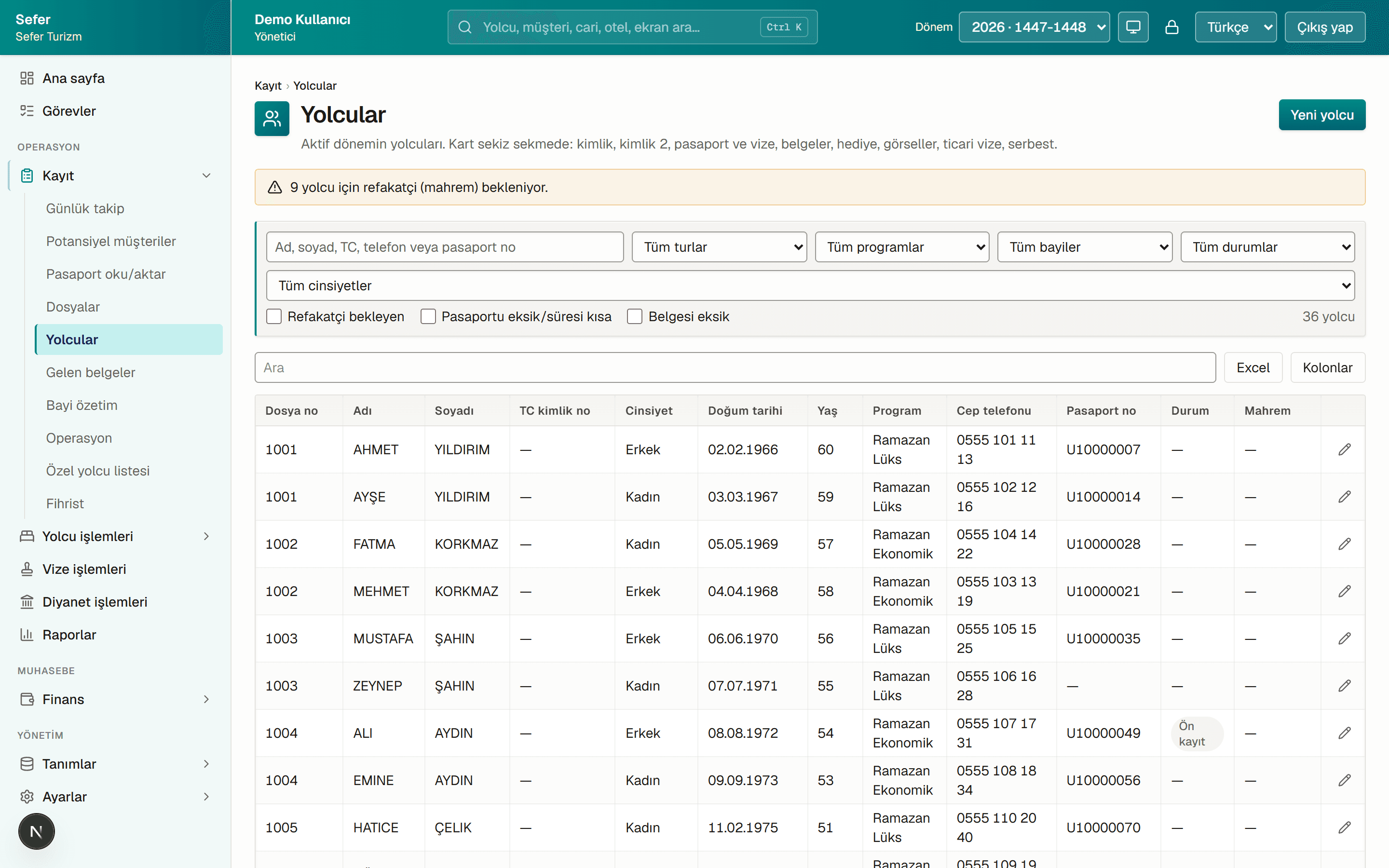
These are not marketing illustrations. They are drawn with the application's own components and colours — the same layouts your team will use.
The list that opens the morning
A lead list is not a notebook. Every lead carries a next-call date, and the list splits into overdue, today and never-called. Recording a conversation sets the next appointment automatically — nobody drops off the list quietly.
Agencies lose money on the lead nobody called twice, not on a rooming mistake.
Barcode roll call at the airport
Your officer is standing in a crowd, not sitting at a desk. The barcode on the passport is scanned; because readers act as keyboards, there is no driver, no local agent and no setup.
Scanning the same passport twice does not remove the passenger — the easiest mistake to make in a crowd.
The passenger's own page
“How much do I still owe”, “which hotel”, “what time is the flight” — most incoming calls are these four questions. The passenger receives a read-only link: balance, payment plan, missing documents, hotel, flight and room.
No password, no account. The link expires and can be revoked at any moment.
What it looks like
Seven modules, one system
How it works
Five steps from setup to first departure
The order is the same in every agency. Definitions are entered once; the rest repeats for each departure.
- 1
Enter your definitions once
Hotels, room rates, airlines, cities, staff, sub-agents and document templates. This happens once at setup; every later departure builds on the same definitions.
- 2
Open the tour and its departures
Choose the tour type and year, then create departures beneath it: Makkah and Madinah stays, prices by room type, quota and itinerary legs. Last season's departure can be copied and re-dated.
- 3
Turn the enquiry into a booking
Someone calling to ask a price is opened as a lead and lands on the follow-up list. When it converts, the booking file and passenger records are created from the same information, and charges are calculated automatically.
- 4
Plan the operation
Passengers are grouped and allocated to rooms in Makkah and Madinah, then given aircraft and coach seats. Missing documents and passports too close to expiry are listed in order of days remaining before departure.
- 5
Depart and close
Barcode check-in at the airport, passenger and rooming lists, badge cards. When the tour ends, profit and loss is calculated per departure and any uncollected balance stays under follow-up.
What's inside
The agency's work is not split across tools: the same passenger record serves sales, visas, operations and accounting.
What's inside
Seven modules, one system
The agency's work is not split across tools: the same passenger record serves sales, visas, operations and accounting.
Why this system
Six things that make the difference
What follows is not a feature list. Each line answers a concrete loss that an operator working by hand — or with a general-purpose package — runs into sooner or later, and all of them come from the working rules of a Hajj and Umrah system that has been in the field for over a decade.
Makkah and Madinah rooms are paired
The two cities are planned separately, yet the same family stays together in both; any unpaired room stays flagged in the list. On a hand-kept plan the family gets split in the second city, and that is usually discovered at the hotel reception desk.
Age counts from the departure date, not the booking date
A child who is eleven at booking is twelve at departure. A system that ages from the booking date prices them wrongly, and the gap surfaces after the invoice is issued. Here age is always calculated from the departure date.
Dollars and local currency are never added together
Each currency keeps its own balance line, and every movement freezes the rate of its own day. A later rate change does not rewrite past receipts — the "but I paid you in March" argument ends at the statement.
Regulatory rules live in settings, not in the code
Mahram age limits, passport validity thresholds and accompaniment conditions are configured per agency. When the rule on the Saudi side changes there is no release to wait for: change the setting, and the next morning's lists follow the new rule.
Data separation is enforced in the database
The boundary between agencies, and between sub-agents, lives in database policy rather than application code. One forgotten line in a query cannot expose another agency's or another sub-agent's records.
Runs in the browser, nothing to install
The same system in the office, at home and at the airport. No restart to change the working year, nobody walking desk to desk to update, no backup file to hunt for at year end.
Glossary
The language of the trade
Mahram, quota, holds, itinerary legs, PNR — the terms used every day in an agency, and how the system handles each one.
FAQ
Common questions
Can we migrate our existing data?
Tours, programmes, hotels and ledger definitions can be imported. Starting with the active season rather than every past year usually produces results faster; we decide together during setup.
How many users can we have?
User and branch counts depend on the package. Roles are separate: accounting staff do not see registration screens and registration staff do not see finance.
Where is our data stored?
Server location follows the applicable regulation. Passport and identity data is stored encrypted and every access is logged.
What happens if the internet goes down?
The system runs in the browser and needs a connection. Lists used at critical moments, such as departure day, can be printed as PDFs in advance.
Can it be used outside Turkey?
Yes. The interface is available in Turkish, English and Arabic, with a full right-to-left layout in Arabic. Currency, tax and integration settings are configured per agency.
How long does setup take?
The system is usable once the definitions — hotels, tours, programmes, staff — are entered. Duration depends on how many tours you run; we plan it together during setup.
Let's set it up together
Tell us how your tours, pricing and team are structured; we will show the demo on a setup that resembles your own data.